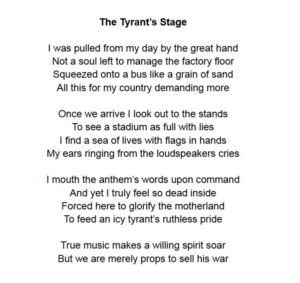
“The Tyrant’s Stage” is a sonnet going through the feelings of a working-class
Russian citizen forced to attend Putin’s war concert to celebrate the military. I decided to
come up with a modern version of the Shakespearean sonnet by changing the rhyming
scheme. I wanted to create an echoey feeling while reading to signify how if most of
these Russian citizens were not forced to attend the concert, the stadium would be
empty and echoey. I am really happy with how that turned out because it is unique to
the topic of this poem.
The first stanza described the life of the citizen. The imagery of being “pulled
from my day by the great hand” and “squeezed onto a bus like a grain of sand”
emphasizes a loss of individuality. It shows that the worker is no longer a person with a
life, but rather a tool to advance the country’s infrastructure and economic growth.
The second stanza described the massive scale of this event and the
propaganda spread during the show. I wanted to show a contrast from this event and a
Western large-scale concert by depicting the stadium as being “full with lies” while also
describing the size by the flag-waving “sea of lives.” I also wanted to include some
images of the audio in this event. The subject doesn’t want to hear the propaganda war
songs, so I used the “loudspeakers’ cries” as a way to convey how overwhelming it was
to be there. The ears ringing suggests a violent assault of propaganda in contrast to the
celebratory concert as it was meant to be.
The third stanza really hones in on the personal feelings of the person showing
their disgust and thoughts of the performance. The act of “mouthing the anthem’s
words” shows a disconnect of pride in one’s country for more of an indifference for
Russia. Feeling dead inside brings life into the matter. I assume that if a person is
uncooperative with the government, then there may be punishments that include death.
I wanted to show a sense of survival and the only way to survive was to be obedient to
the “icy tyrant’s” rule.
I really enjoyed writing this because I am not the fondest of creative writing.
Stepping out of my comfort zone helped me capture some of the emotions I felt while
learning about this topic. Instead of just reading facts and data, I put myself in the shoes
of a citizen and made the reality of government-forced propaganda feel personal rather
than analytical.
Avrum Horsley, a Second-Year Student Majoring in Computer Science